

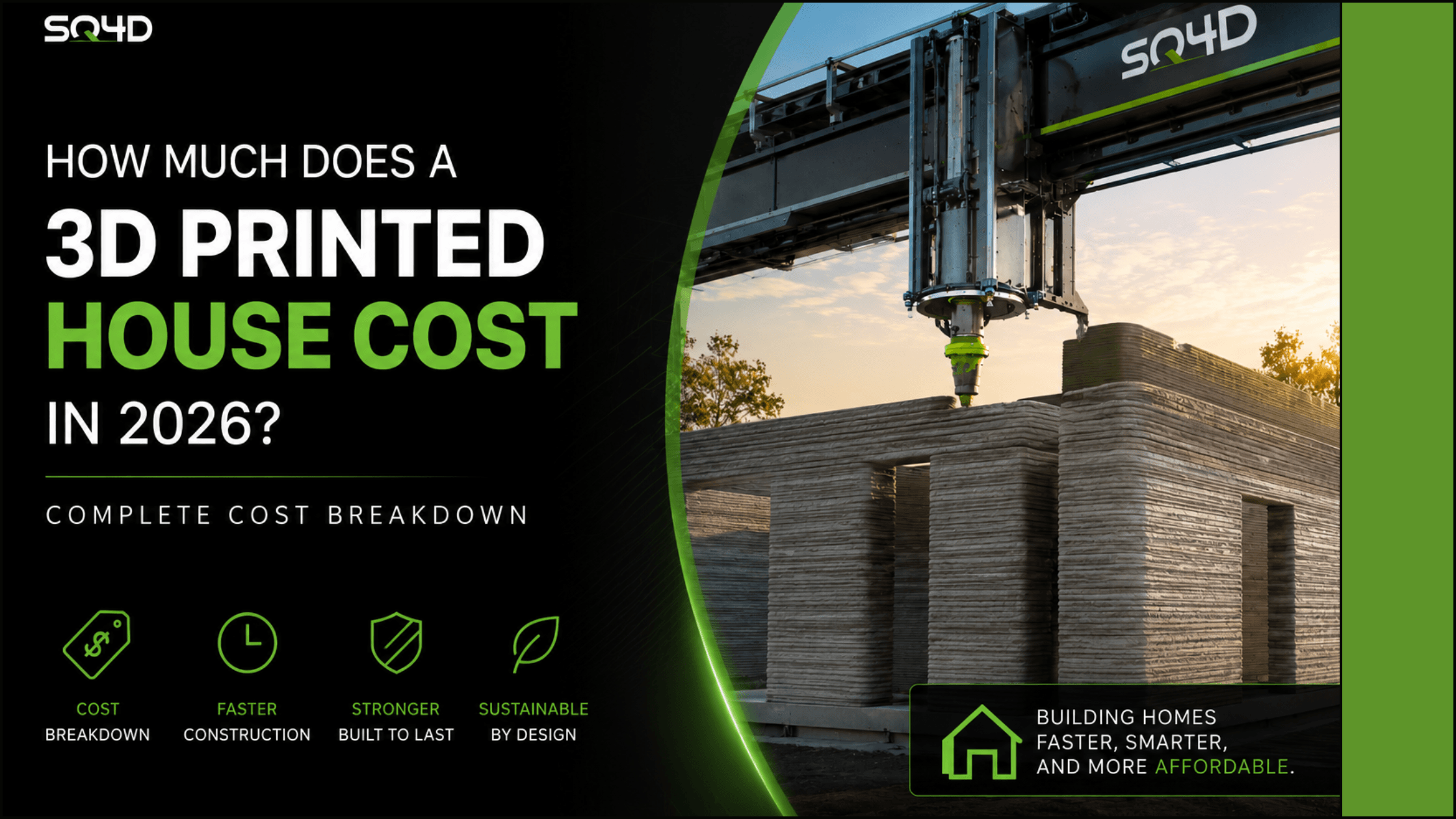
How Much Does a 3D Printed House Cost in 2026? Complete Cost Breakdown
As housing prices continue to rise and construction labor shortages affect projects across the country, many homebuyers, developers, and investors are looking at 3D printed homes as a faster and potentially more affordable alternative to traditional construction.
One of the most common questions people ask is: How much does a 3D printed house cost in 2026?
The answer depends on several factors, including the home’s size, location, design complexity, foundation requirements, utilities, and finishing materials. While costs vary, advances in concrete 3D printing technology have made it possible to significantly reduce labor costs, shorten construction timelines, and minimize material waste compared to conventional building methods.
In this guide, we’ll break down the real cost of a 3D printed house, explain what factors affect pricing, and explore how companies like SQ4D are changing the future of home construction.
Quick Answer: How Much Does a 3D Printed House Cost?
In 2026, the total cost of a completed 3D printed home typically ranges from:
| Home Type | Estimated Cost |
| Small Home (500–1,000 sq. ft.) | $100,000–$200,000 |
| Mid-Size Home (1,000–2,000 sq. ft.) | $200,000–$450,000 |
| Large Custom Home (2,000+ sq. ft.) | $450,000–$800,000+ |
These estimates generally include:
- Foundation
- Structural walls
- Roofing
- Electrical systems
- Plumbing
- HVAC
- Interior finishes
- Permits and inspections
However, the actual cost can vary significantly depending on location and project specifications.
How Much of The Home can be 3D Printed?
Many people assume a 3D printer builds an entire house from start to finish. In reality, most construction 3D printers focus on creating the main building structure. At SQ4D we go a few steps further, we not only build the main structure but also the walls, foundation and roof. foundation,
| What’s Included | SQ4D | Other Companies |
| Main Building Structure | Yes | Yes |
| Foundation | Yes | No |
| Roofing | Yes | No |
| Interior & Exterior Walls | Yes | No |
Additional components still need to be installed, including:
Doors and Windows
Openings are designed into the print process, but windows and doors are installed separately.
Electrical and Plumbing
Utilities must be integrated into the finished structure according to local building codes.
HVAC Systems
Heating and cooling systems remain similar to those used in conventional homes.
Interior Finishes
Flooring, cabinetry, appliances, paint, fixtures, and other finishes.
Why Are 3D Printed Homes Less Expensive?
The primary advantage of concrete 3D printing is the reduction in labor and construction time.
Traditional home construction often requires multiple subcontractors working sequentially over several months. With a large-scale concrete 3D printer, the structural shell can be completed much faster while requiring fewer workers on-site.
Key Cost Savings Include:
Reduced Labor Costs
Labor is one of the largest expenses in residential construction. In addition to the cost it’s also difficult to find skilled labor, they are not always readily accessible. With digital construction using a 3D printer, there is a shorter barrier to entry in both time and skillset requirements.
Faster Construction Timelines
A printed structure can be completed in a fraction of the time required by traditional framing methods.
Less Material Waste
Conventional construction generates substantial waste from cutoffs, packaging, and excess materials. Automated printing deposits material only where it is needed. Any excess material or mistakes can then be recycled into other projects by reusing them as course aggregate for another slab, driveway, walkway or even a patio.
Increased Efficiency
Constructing with a 3d printer is more efficient because a machine does not need rest. The printer does not need food, so as long as an operator is there to watch (babysit) the machine, theoretically, the machine can print 24/7 in ideal conditions.
Reduced Failures
3d concrete construction significantly reduces the human error of translating plans to build. Our machine allows us to take the CAD models directly from the architects and engineers and layout the plans into our print. We can then spray paint and mark out where important features are such as, stub outs for electrical/ plumbing, doorways, windows, locations for lights. After mark outs are done, the machine will “print” the walls exactly to the plans.
Cost Comparison: 3D Printed Homes vs Traditional Homes
One of the biggest reasons homeowners are exploring concrete 3D printing is the potential for cost savings.
| Construction Method | Typical Cost Per Sq. Ft. |
| Traditional Construction | $150–$400+ |
| Modular Construction | $100–$250 |
| Concrete 3D Printing | Potentially Lower Depending on Design and Scale |
While costs vary by market, concrete 3D printing can reduce several major construction expenses through automation and streamlined workflows.
The greatest savings are often realized on larger projects where labor reductions and construction speed have the greatest impact.
What Factors Affect the Cost of a 3D Printed House?
Home Size
Larger homes require more material, longer print times, and additional finishing work.
Architectural Complexity
Simple floor plans are generally less expensive than highly customized designs with unique features. With 3D printing you can very easily make round inside and outside corners, which is complex and difficult for lumber construction. This allows for more organic, fluid, designs for architects to explore.
At the same time you can also have cookie cutter designs/plans that can be rinsed and repeated to build homes at scale making it ideal for developers.
Geographic Location
Land prices, permitting requirements, labor rates, utility connections, and transportation costs all vary by region.
Building Codes
Local regulations can influence engineering requirements and overall project costs.
Interior Finish Level
A luxury kitchen and premium finishes can dramatically increase the final cost of any home, regardless of how it was constructed.
Site Preparation
Clearing land, grading, utility connections, and foundation work can represent a significant portion of the total project budget.
How Fast Can a 3D Printed House Be Built?
One of the most impressive aspects of construction-scale 3D printing is speed.
Traditional home construction can take several months or even longer, depending on labor availability and weather conditions.
By comparison, advanced systems such as SQ4D’s ARCS technology can print structural walls in a matter of hours rather than weeks.
This accelerated timeline can reduce project delays, lower labor costs, and allow homes to reach completion faster than many traditional construction methods.
Are 3D Printed Homes Durable?
Durability is another frequently asked question.
Concrete has long been recognized for its strength and longevity, and concrete 3D printed homes are designed to provide many of the same advantages.
Potential benefits include:
- Resistance to rot
- Resistance to termites
- Improved durability compared to wood framing
- Reduced maintenance requirements
- Enhanced weather resistance
Because the structural system is made from concrete rather than lumber, many printed homes are designed to withstand challenging environmental conditions.
Are 3D Printed Homes Energy Efficient?
Many concrete 3D printed homes are designed with energy efficiency in mind. Traditional lumber construction primarily relies on 2×4 or 2×6 wooden planks for the exterior walls which only allows for 3.5″ – 5.5″ inches of insulation. 3D printing technology allows us the ability to increase the amount of space between the interior and exterior walls.
Benefits may include:
- Improved thermal mass
- Reduced air leakage
- Increased insulation between interior and exterior walls
- Lower heating and cooling costs
- More sustainable construction practices
Combined with solar systems, efficient HVAC equipment, and smart home technology, 3D printed homes may help reduce long-term operating expenses.
Frequently Asked Questions About 3D Printed House Costs
What is the average cost of a 3D printed house?
Most completed 3D printed homes currently fall between $100,000 and $450,000 depending on size, location, and finishes.
Is a 3D printed house cheaper than a traditional house?
In many situations, concrete 3D printing can reduce labor costs and construction timelines, potentially lowering overall project expenses. In traditional construction you can estimate that between 10-20% additional material needs to be ordered to account for mistakes, defects in products, and unaccounted events. 3D printing construction, the only 3 materials needed are sand, portland cement, and water, which all come locally from a quarry or from city municipalities.
How long do 3D printed homes last?
Because they use concrete as a primary structural material, properly designed and maintained 3D printed homes may last for decades longer than traditionally lumber framed structures.
Can you get a mortgage on a 3D printed house?
Financing options continue to expand as lenders become more familiar with construction-scale 3D printing technologies.
Are 3D printed homes safe?
Yes. Due to their resistance to fire, water, and wind damage, 3D printed homes greatly lower the risk of not only property damage but the loss of life that could result from a natural disaster.
The Future of Affordable Housing May Be 3D Printed
As construction costs continue to rise, the housing industry is searching for new ways to build homes faster, more efficiently, and more sustainably.
Concrete 3D printing offers a compelling solution by reducing labor requirements, minimizing material waste, accelerating construction timelines, and creating durable structures designed for long-term performance.
Companies like SQ4D are demonstrating that full-scale 3D printed homes are no longer a concept of the future—they are being built today.
As the technology continues to evolve, 3D printed construction could play an increasingly important role in making housing more accessible, affordable, and resilient for future generations.